



Click Below to Get the Code

Browse, clone, and build from real-world templates powered by Harper.
Solution
GitHub Logo

Prerender with Dynamic Attributes

Harper lets teams pre-render pages for global speed while keeping prices, inventory, and promos live by storing fast-changing values as lightweight attributes and injecting them at request time. By unifying database, cache, messaging, and runtime in a distributed platform, it removes ISR/API complexity, avoids full-page revalidation, and delivers static-level performance without rewrites or stack changes.
Solution

Prerender with Dynamic Attributes

Harper
at Harper
August 26, 2025
Harper
at Harper
August 26, 2025
Harper
at Harper
August 26, 2025
August 26, 2025
Harper lets teams pre-render pages for global speed while keeping prices, inventory, and promos live by storing fast-changing values as lightweight attributes and injecting them at request time. By unifying database, cache, messaging, and runtime in a distributed platform, it removes ISR/API complexity, avoids full-page revalidation, and delivers static-level performance without rewrites or stack changes.
Harper

In digital commerce, speed drives growth. Faster pages improve user experience, boost conversions, and lift SEO—but dynamic content often gets in the way.

When prices, inventory, or promos are always changing, pre-rendering can seem out of reach. Most tools treat dynamic data as a blocker.

Harper makes it a feature.

The Shortcomings of Traditional Approaches

Most modern web stacks force a choice between speed and flexibility.

Frameworks like Next.js attempt to bridge the gap with features like Incremental Static Regeneration (ISR), but they still rely on external APIs and separate data layers that introduce latency and complexity. Every dynamic update requires cache revalidation, regeneration logic, and additional infrastructure to scale cleanly.

Meanwhile, traditional CDNs offer excellent performance for static assets, but treat caching as an all-or-nothing operation. You can cache the whole page or not at all. That binary model makes serving real-time data messy, brittle, and expensive.

At scale, even small performance penalties compound, adding milliseconds for every round-trip between origin, application, and data layers.


For 95% of users, Harper delivers full page load in under 600 ms.

* Assumes in-region PoPs, pre-rendered HTML with dynamic values computed in ~200 ms server time, HTTP/2+keep-alive, and typical broadband/LTE conditions. First-hit connections and large payloads may be higher.

The Harper Solution

Harper makes pre-rendering viable for dynamic, data-rich experiences. By unifying the database, cache, messaging, and app layer into a single distributed platform, Harper delivers the speed of static rendering with the flexibility of live data, no rewrites required.
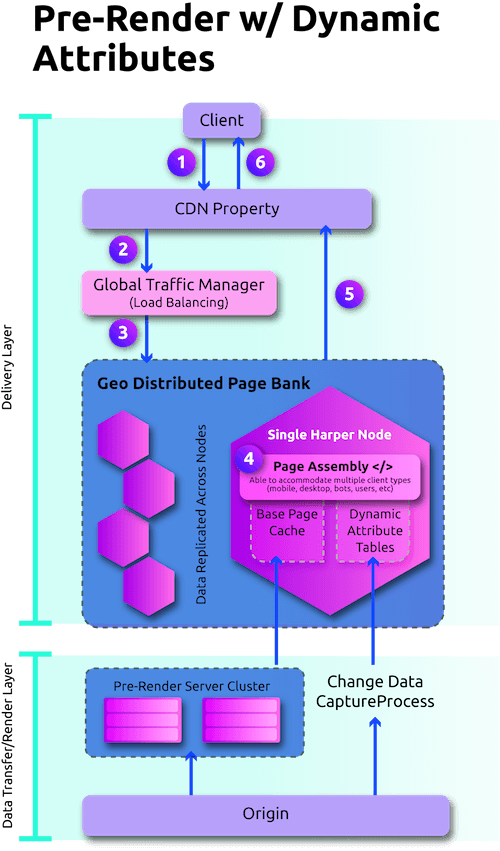
How it works:
You pre-render the core layout and content of a page—everything that rarely changes—and cache it globally. The fast-changing elements, like price or inventory, are stored in a lightweight attributes table directly within Harper’s runtime. When a request comes in, those values are injected on the fly with nearly no detectable latency penalty, typically in just 1 or 2 milliseconds.

Unlike ISR or API-bound solutions, Harper eliminates the need to regenerate entire pages or manage complicated revalidation logic. Your frontend doesn’t change. Your stack doesn’t have to move. You just layer Harper in front and start shipping faster experiences.

And because Harper’s architecture is distributed by default, both content and data live closer to every user, delivering consistently fast performance no matter where in the world your customers are.

Conclusion

Pre-rendering doesn’t have to come at the cost of freshness, and real-time data doesn’t have to slow you down.

Harper’s dynamic attribute prerendering unlocks a new model for digital commerce performance: fast, flexible, and fully future-ready. Whether you’re optimizing for search bots or real buyers, the results speak for themselves.

Ready to move faster? Let’s talk.

In digital commerce, speed drives growth. Faster pages improve user experience, boost conversions, and lift SEO—but dynamic content often gets in the way.

When prices, inventory, or promos are always changing, pre-rendering can seem out of reach. Most tools treat dynamic data as a blocker.

Harper makes it a feature.

The Shortcomings of Traditional Approaches

Most modern web stacks force a choice between speed and flexibility.

Frameworks like Next.js attempt to bridge the gap with features like Incremental Static Regeneration (ISR), but they still rely on external APIs and separate data layers that introduce latency and complexity. Every dynamic update requires cache revalidation, regeneration logic, and additional infrastructure to scale cleanly.

Meanwhile, traditional CDNs offer excellent performance for static assets, but treat caching as an all-or-nothing operation. You can cache the whole page or not at all. That binary model makes serving real-time data messy, brittle, and expensive.

At scale, even small performance penalties compound, adding milliseconds for every round-trip between origin, application, and data layers.


For 95% of users, Harper delivers full page load in under 600 ms.

* Assumes in-region PoPs, pre-rendered HTML with dynamic values computed in ~200 ms server time, HTTP/2+keep-alive, and typical broadband/LTE conditions. First-hit connections and large payloads may be higher.

The Harper Solution

Harper makes pre-rendering viable for dynamic, data-rich experiences. By unifying the database, cache, messaging, and app layer into a single distributed platform, Harper delivers the speed of static rendering with the flexibility of live data, no rewrites required.

How it works:
You pre-render the core layout and content of a page—everything that rarely changes—and cache it globally. The fast-changing elements, like price or inventory, are stored in a lightweight attributes table directly within Harper’s runtime. When a request comes in, those values are injected on the fly with nearly no detectable latency penalty, typically in just 1 or 2 milliseconds.

Unlike ISR or API-bound solutions, Harper eliminates the need to regenerate entire pages or manage complicated revalidation logic. Your frontend doesn’t change. Your stack doesn’t have to move. You just layer Harper in front and start shipping faster experiences.

And because Harper’s architecture is distributed by default, both content and data live closer to every user, delivering consistently fast performance no matter where in the world your customers are.

Conclusion

Pre-rendering doesn’t have to come at the cost of freshness, and real-time data doesn’t have to slow you down.

Harper’s dynamic attribute prerendering unlocks a new model for digital commerce performance: fast, flexible, and fully future-ready. Whether you’re optimizing for search bots or real buyers, the results speak for themselves.

Ready to move faster? Let’s talk.

Harper lets teams pre-render pages for global speed while keeping prices, inventory, and promos live by storing fast-changing values as lightweight attributes and injecting them at request time. By unifying database, cache, messaging, and runtime in a distributed platform, it removes ISR/API complexity, avoids full-page revalidation, and delivers static-level performance without rewrites or stack changes.

Download

White arrow pointing right
Harper lets teams pre-render pages for global speed while keeping prices, inventory, and promos live by storing fast-changing values as lightweight attributes and injecting them at request time. By unifying database, cache, messaging, and runtime in a distributed platform, it removes ISR/API complexity, avoids full-page revalidation, and delivers static-level performance without rewrites or stack changes.

Download

White arrow pointing right
Harper lets teams pre-render pages for global speed while keeping prices, inventory, and promos live by storing fast-changing values as lightweight attributes and injecting them at request time. By unifying database, cache, messaging, and runtime in a distributed platform, it removes ISR/API complexity, avoids full-page revalidation, and delivers static-level performance without rewrites or stack changes.

Download

White arrow pointing right

Explore Recent Resources

News
GitHub Logo

Harper Recognized as an Honorable Mention in the 2026 Gartner® Magic Quadrant™ for Cloud-Native Application Platforms

Harper’s inclusion highlights a broader shift toward integrated cloud-native platforms that unify data, caching, messaging, and application logic. The article explains how Harper’s distributed runtime and managed infrastructure reduce operational complexity, improve performance, and support modern applications and AI agents that require fast, reliable access to state, events, and tools.
Announcement
News
Harper’s inclusion highlights a broader shift toward integrated cloud-native platforms that unify data, caching, messaging, and application logic. The article explains how Harper’s distributed runtime and managed infrastructure reduce operational complexity, improve performance, and support modern applications and AI agents that require fast, reliable access to state, events, and tools.
Person with short dark hair and moustache, wearing a colorful plaid shirt, smiling outdoors in a forested mountain landscape.
Aleks Haugom
Senior Manager of GTM
News

Harper Recognized as an Honorable Mention in the 2026 Gartner® Magic Quadrant™ for Cloud-Native Application Platforms

Harper’s inclusion highlights a broader shift toward integrated cloud-native platforms that unify data, caching, messaging, and application logic. The article explains how Harper’s distributed runtime and managed infrastructure reduce operational complexity, improve performance, and support modern applications and AI agents that require fast, reliable access to state, events, and tools.
Aleks Haugom
Aug 2026
News

Harper Recognized as an Honorable Mention in the 2026 Gartner® Magic Quadrant™ for Cloud-Native Application Platforms

Harper’s inclusion highlights a broader shift toward integrated cloud-native platforms that unify data, caching, messaging, and application logic. The article explains how Harper’s distributed runtime and managed infrastructure reduce operational complexity, improve performance, and support modern applications and AI agents that require fast, reliable access to state, events, and tools.
Aleks Haugom
News

Harper Recognized as an Honorable Mention in the 2026 Gartner® Magic Quadrant™ for Cloud-Native Application Platforms

Harper’s inclusion highlights a broader shift toward integrated cloud-native platforms that unify data, caching, messaging, and application logic. The article explains how Harper’s distributed runtime and managed infrastructure reduce operational complexity, improve performance, and support modern applications and AI agents that require fast, reliable access to state, events, and tools.
Aleks Haugom
News
GitHub Logo

Harper 5.2: More Throughput per Node, Fewer Systems Around It

Harper 5.2 helps architecture and platform leaders improve performance, control infrastructure costs, secure production workloads, and reduce operational complexity by bringing faster data access, agentic capabilities, scheduling, backup, routing, and protection into one unified runtime.
Product Update
News
Harper 5.2 helps architecture and platform leaders improve performance, control infrastructure costs, secure production workloads, and reduce operational complexity by bringing faster data access, agentic capabilities, scheduling, backup, routing, and protection into one unified runtime.
Person with short dark hair and moustache, wearing a colorful plaid shirt, smiling outdoors in a forested mountain landscape.
Aleks Haugom
Senior Manager of GTM
News

Harper 5.2: More Throughput per Node, Fewer Systems Around It

Harper 5.2 helps architecture and platform leaders improve performance, control infrastructure costs, secure production workloads, and reduce operational complexity by bringing faster data access, agentic capabilities, scheduling, backup, routing, and protection into one unified runtime.
Aleks Haugom
Aug 2026
News

Harper 5.2: More Throughput per Node, Fewer Systems Around It

Harper 5.2 helps architecture and platform leaders improve performance, control infrastructure costs, secure production workloads, and reduce operational complexity by bringing faster data access, agentic capabilities, scheduling, backup, routing, and protection into one unified runtime.
Aleks Haugom
News

Harper 5.2: More Throughput per Node, Fewer Systems Around It

Harper 5.2 helps architecture and platform leaders improve performance, control infrastructure costs, secure production workloads, and reduce operational complexity by bringing faster data access, agentic capabilities, scheduling, backup, routing, and protection into one unified runtime.
Aleks Haugom
Blog
GitHub Logo

5 Architectures for Web Personalization

Personalization is a data-delivery problem. Every architectural choice reduces to two distances: compute to user, and compute to fresh data. This piece maps five real architectures against both axes, scored on a concrete retailer workload where stale or slow data breaks the business.
Blog
Personalization is a data-delivery problem. Every architectural choice reduces to two distances: compute to user, and compute to fresh data. This piece maps five real architectures against both axes, scored on a concrete retailer workload where stale or slow data breaks the business.
Person with short dark hair and moustache, wearing a colorful plaid shirt, smiling outdoors in a forested mountain landscape.
Aleks Haugom
Senior Manager of GTM
Blog

5 Architectures for Web Personalization

Personalization is a data-delivery problem. Every architectural choice reduces to two distances: compute to user, and compute to fresh data. This piece maps five real architectures against both axes, scored on a concrete retailer workload where stale or slow data breaks the business.
Aleks Haugom
Jul 2026
Blog

5 Architectures for Web Personalization

Personalization is a data-delivery problem. Every architectural choice reduces to two distances: compute to user, and compute to fresh data. This piece maps five real architectures against both axes, scored on a concrete retailer workload where stale or slow data breaks the business.
Aleks Haugom
Blog

5 Architectures for Web Personalization

Personalization is a data-delivery problem. Every architectural choice reduces to two distances: compute to user, and compute to fresh data. This piece maps five real architectures against both axes, scored on a concrete retailer workload where stale or slow data breaks the business.
Aleks Haugom