



Click Below to Get the Code

Browse, clone, and build from real-world templates powered by Harper.
Comparison
GitHub Logo

Feature Update Replicated Writes

Harper 4.4 introduces a new replication system that boosts replicated write performance by 50% due to optimized direct node-to-node connections.
Comparison

Feature Update Replicated Writes

Harper
at Harper
February 25, 2025
Harper
at Harper
February 25, 2025
Harper
at Harper
February 25, 2025
February 25, 2025
Harper 4.4 introduces a new replication system that boosts replicated write performance by 50% due to optimized direct node-to-node connections.
Harper

4.4 Replication System Update

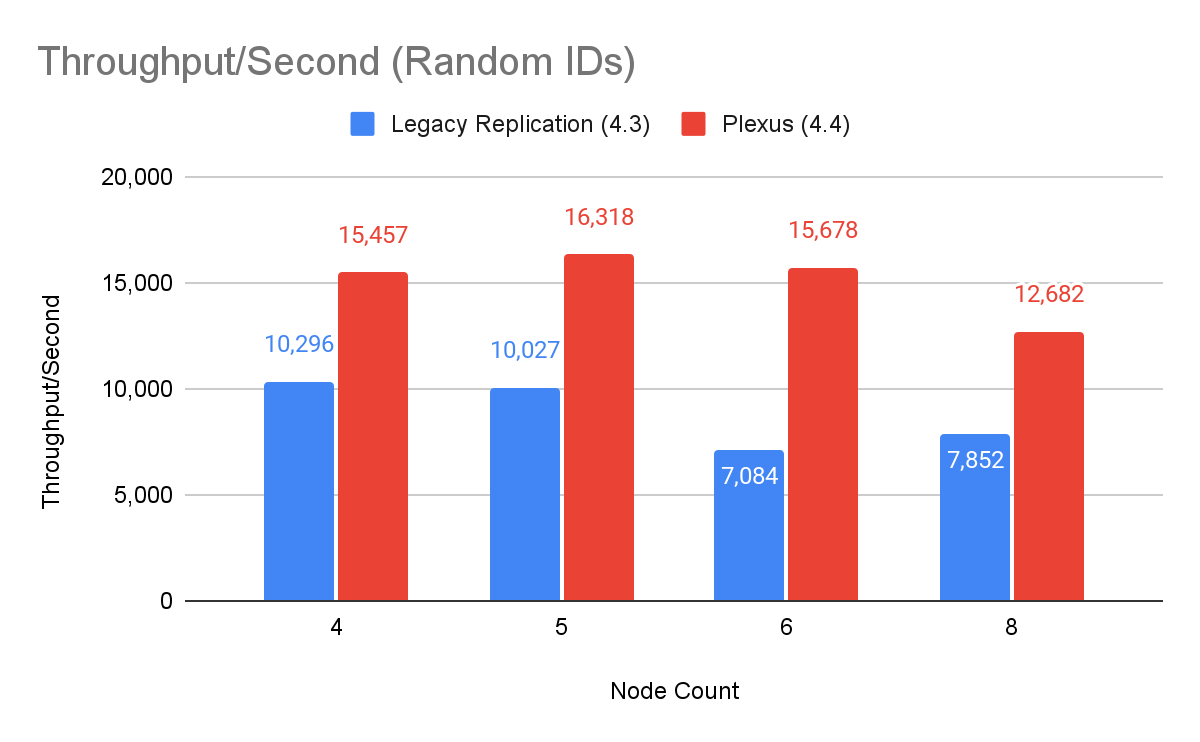
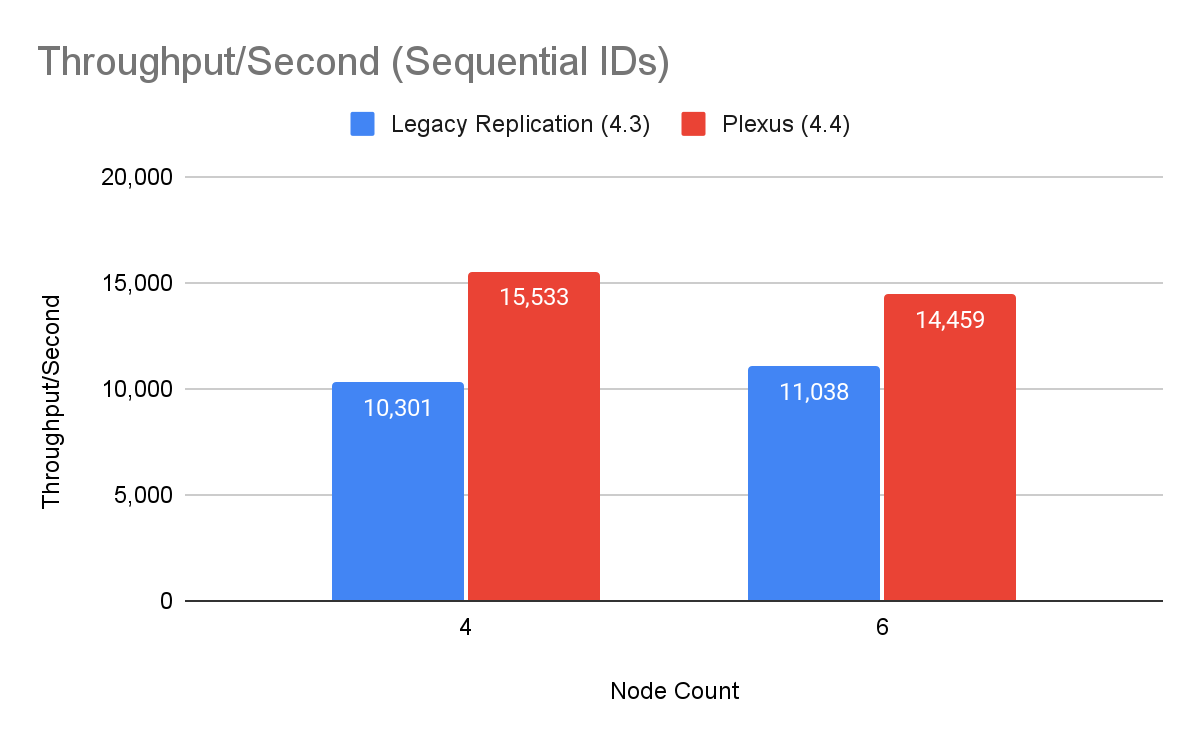
In Harper 4.4, we introduced a new built-in replication system, “Plexus.” This system provides substantial performance, security, and reliability improvements. Plexus eliminates the need to go through a message broker and instead implements direct connections between nodes. This facilitates optimizations down to the TCP level, highly secure mTLS connection, and robust consistency tracking. This highly optimized system for delivery of replicated writes has yielded significant performance gains. Although many factors create variability in test results, we are confident that results show an average 50% increase in replicated write performance over Harper 4.3.

Interpreting the Benchmark Results

The tests specifically focused on measuring throughput for replicated writes and do not reflect write performance for single standalone nodes. In all, 12 different tests were performed across 4, 5, 6, and 8 node clusters, with all writes fully replicated to all nodes. Tests were further divided into two groups, one with random primary keys (Random IDs) and the second with sequential keys (Sequential IDs), to understand variability across use cases. 


Given the small sample size and the hundreds of potential unseen performance variables at play when using cloud virtual machines, the 6-node Random IDs result was removed after it demonstrated a 121% increase in performance. With outliers removed, the remaining results showed a mean performance improvement of 51% with a standard deviation of 9%.
It is worth noting that sharding was not enabled for these tests. With sharding enabled, higher overall write throughput can be expected across the system, as writes are not committed to each independent node. 

Test Setup

Benchmarks utilized a multi-node Harper cluster and compared database write performance given the following specifications: 

  • Record Size: 400 bytes, 8 fields
  • High concurrency: 500 virtual users writing
  • All writes are new records (inserts) using the POST method of the REST API and are replicated to all other nodes. 
  • ID Specifications: some text
    • Random IDs: Primary keys that are random UUIDs (this is a little slower than sequential IDs, but more reflective of typical usage patterns in practice)
    • Sequential IDs: Primary keys that are sequentially generated.
  • All tests were performed on 16GB Dedicated CPU Compute Akamai Connected Cloud Instances. 
  • The tests used a separate instance for each Harper node and another separate instance to execute the load test runner. 
  • The load tests were performed by k6.

4.4 Replication System Update

In Harper 4.4, we introduced a new built-in replication system, “Plexus.” This system provides substantial performance, security, and reliability improvements. Plexus eliminates the need to go through a message broker and instead implements direct connections between nodes. This facilitates optimizations down to the TCP level, highly secure mTLS connection, and robust consistency tracking. This highly optimized system for delivery of replicated writes has yielded significant performance gains. Although many factors create variability in test results, we are confident that results show an average 50% increase in replicated write performance over Harper 4.3.

Interpreting the Benchmark Results

The tests specifically focused on measuring throughput for replicated writes and do not reflect write performance for single standalone nodes. In all, 12 different tests were performed across 4, 5, 6, and 8 node clusters, with all writes fully replicated to all nodes. Tests were further divided into two groups, one with random primary keys (Random IDs) and the second with sequential keys (Sequential IDs), to understand variability across use cases. 


Given the small sample size and the hundreds of potential unseen performance variables at play when using cloud virtual machines, the 6-node Random IDs result was removed after it demonstrated a 121% increase in performance. With outliers removed, the remaining results showed a mean performance improvement of 51% with a standard deviation of 9%.

It is worth noting that sharding was not enabled for these tests. With sharding enabled, higher overall write throughput can be expected across the system, as writes are not committed to each independent node. 

Test Setup

Benchmarks utilized a multi-node Harper cluster and compared database write performance given the following specifications: 

  • Record Size: 400 bytes, 8 fields
  • High concurrency: 500 virtual users writing
  • All writes are new records (inserts) using the POST method of the REST API and are replicated to all other nodes. 
  • ID Specifications: some text
    • Random IDs: Primary keys that are random UUIDs (this is a little slower than sequential IDs, but more reflective of typical usage patterns in practice)
    • Sequential IDs: Primary keys that are sequentially generated.
  • All tests were performed on 16GB Dedicated CPU Compute Akamai Connected Cloud Instances. 
  • The tests used a separate instance for each Harper node and another separate instance to execute the load test runner. 
  • The load tests were performed by k6.

Harper 4.4 introduces a new replication system that boosts replicated write performance by 50% due to optimized direct node-to-node connections.

Download

White arrow pointing right
Harper 4.4 introduces a new replication system that boosts replicated write performance by 50% due to optimized direct node-to-node connections.

Download

White arrow pointing right
Harper 4.4 introduces a new replication system that boosts replicated write performance by 50% due to optimized direct node-to-node connections.

Download

White arrow pointing right

Explore Recent Resources

News
GitHub Logo

Harper Recognized as an Honorable Mention in the 2026 Gartner® Magic Quadrant™ for Cloud-Native Application Platforms

Harper’s inclusion highlights a broader shift toward integrated cloud-native platforms that unify data, caching, messaging, and application logic. The article explains how Harper’s distributed runtime and managed infrastructure reduce operational complexity, improve performance, and support modern applications and AI agents that require fast, reliable access to state, events, and tools.
Announcement
News
Harper’s inclusion highlights a broader shift toward integrated cloud-native platforms that unify data, caching, messaging, and application logic. The article explains how Harper’s distributed runtime and managed infrastructure reduce operational complexity, improve performance, and support modern applications and AI agents that require fast, reliable access to state, events, and tools.
Person with short dark hair and moustache, wearing a colorful plaid shirt, smiling outdoors in a forested mountain landscape.
Aleks Haugom
Senior Manager of GTM
News

Harper Recognized as an Honorable Mention in the 2026 Gartner® Magic Quadrant™ for Cloud-Native Application Platforms

Harper’s inclusion highlights a broader shift toward integrated cloud-native platforms that unify data, caching, messaging, and application logic. The article explains how Harper’s distributed runtime and managed infrastructure reduce operational complexity, improve performance, and support modern applications and AI agents that require fast, reliable access to state, events, and tools.
Aleks Haugom
Aug 2026
News

Harper Recognized as an Honorable Mention in the 2026 Gartner® Magic Quadrant™ for Cloud-Native Application Platforms

Harper’s inclusion highlights a broader shift toward integrated cloud-native platforms that unify data, caching, messaging, and application logic. The article explains how Harper’s distributed runtime and managed infrastructure reduce operational complexity, improve performance, and support modern applications and AI agents that require fast, reliable access to state, events, and tools.
Aleks Haugom
News

Harper Recognized as an Honorable Mention in the 2026 Gartner® Magic Quadrant™ for Cloud-Native Application Platforms

Harper’s inclusion highlights a broader shift toward integrated cloud-native platforms that unify data, caching, messaging, and application logic. The article explains how Harper’s distributed runtime and managed infrastructure reduce operational complexity, improve performance, and support modern applications and AI agents that require fast, reliable access to state, events, and tools.
Aleks Haugom
News
GitHub Logo

Harper 5.2: More Throughput per Node, Fewer Systems Around It

Harper 5.2 helps architecture and platform leaders improve performance, control infrastructure costs, secure production workloads, and reduce operational complexity by bringing faster data access, agentic capabilities, scheduling, backup, routing, and protection into one unified runtime.
Product Update
News
Harper 5.2 helps architecture and platform leaders improve performance, control infrastructure costs, secure production workloads, and reduce operational complexity by bringing faster data access, agentic capabilities, scheduling, backup, routing, and protection into one unified runtime.
Person with short dark hair and moustache, wearing a colorful plaid shirt, smiling outdoors in a forested mountain landscape.
Aleks Haugom
Senior Manager of GTM
News

Harper 5.2: More Throughput per Node, Fewer Systems Around It

Harper 5.2 helps architecture and platform leaders improve performance, control infrastructure costs, secure production workloads, and reduce operational complexity by bringing faster data access, agentic capabilities, scheduling, backup, routing, and protection into one unified runtime.
Aleks Haugom
Aug 2026
News

Harper 5.2: More Throughput per Node, Fewer Systems Around It

Harper 5.2 helps architecture and platform leaders improve performance, control infrastructure costs, secure production workloads, and reduce operational complexity by bringing faster data access, agentic capabilities, scheduling, backup, routing, and protection into one unified runtime.
Aleks Haugom
News

Harper 5.2: More Throughput per Node, Fewer Systems Around It

Harper 5.2 helps architecture and platform leaders improve performance, control infrastructure costs, secure production workloads, and reduce operational complexity by bringing faster data access, agentic capabilities, scheduling, backup, routing, and protection into one unified runtime.
Aleks Haugom
Blog
GitHub Logo

5 Architectures for Web Personalization

Personalization is a data-delivery problem. Every architectural choice reduces to two distances: compute to user, and compute to fresh data. This piece maps five real architectures against both axes, scored on a concrete retailer workload where stale or slow data breaks the business.
Blog
Personalization is a data-delivery problem. Every architectural choice reduces to two distances: compute to user, and compute to fresh data. This piece maps five real architectures against both axes, scored on a concrete retailer workload where stale or slow data breaks the business.
Person with short dark hair and moustache, wearing a colorful plaid shirt, smiling outdoors in a forested mountain landscape.
Aleks Haugom
Senior Manager of GTM
Blog

5 Architectures for Web Personalization

Personalization is a data-delivery problem. Every architectural choice reduces to two distances: compute to user, and compute to fresh data. This piece maps five real architectures against both axes, scored on a concrete retailer workload where stale or slow data breaks the business.
Aleks Haugom
Jul 2026
Blog

5 Architectures for Web Personalization

Personalization is a data-delivery problem. Every architectural choice reduces to two distances: compute to user, and compute to fresh data. This piece maps five real architectures against both axes, scored on a concrete retailer workload where stale or slow data breaks the business.
Aleks Haugom
Blog

5 Architectures for Web Personalization

Personalization is a data-delivery problem. Every architectural choice reduces to two distances: compute to user, and compute to fresh data. This piece maps five real architectures against both axes, scored on a concrete retailer workload where stale or slow data breaks the business.
Aleks Haugom